· Omar Khayam · Analysis · 9 min read
Rodri vs Messi: Deconstructing the 2026 World Cup Golden Ball Controversy
FIFA awarded the Golden Ball to Rodri over Messi. 81% of fans disagreed. We break down the data, the tactical logic, the structural flaws in FIFA's voting system, and why this decision redefines how football values greatness.

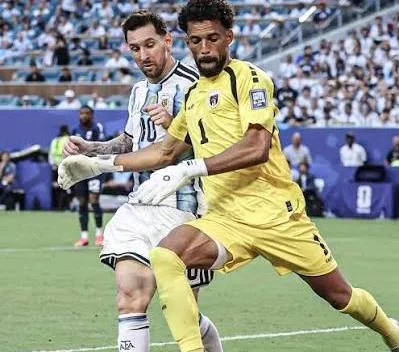
Spain lifted their second World Cup at MetLife Stadium. That was settled on the pitch. What happened on the podium was not.
When FIFA’s Technical Study Group named Rodri as the Golden Ball winner, the 80,663 fans inside the stadium responded with loud, sustained chants of “Messi.” An online poll by Bolavip found 81% of respondents believed Rodri did not deserve the award over Messi.
This was not a simple disagreement about who played better. It exposed a philosophical fracture in how football defines greatness — structural collectivism versus individual heroism.
The individual awards at a glance
Spain swept three of the four major individual accolades. That dominance shaped the narrative around the Golden Ball decision.
| Award | Winner | Team | Key Stat |
|---|---|---|---|
| Golden Ball | Rodri | Spain | 753 passes completed (94% accuracy) |
| Silver Ball | Lionel Messi | Argentina | 8 goals, 4 assists, 5 POTM awards |
| Bronze Ball | Kylian Mbappé | France | 10 goals, 22 career World Cup goals |
| Golden Glove | Unai Simón | Spain | 7 clean sheets, 1 goal conceded |
| Best Young Player | Pau Cubarsí | Spain | Started the final at 19 years old |
The full list of award winners is available on FIFA’s official site.
The statistical case for Rodri
The argument for Rodri was built on volume, precision, and defensive control across eight matches.
He completed 753 passes at 94% accuracy, breaking his own single-tournament World Cup record of 638 set at Qatar 2022. He led Spain in touches (794), accurate final-third passes (173), duels won (41), possessions recovered (34), and tackles (22).
His efficiency in high-pressure zones stood out most. From 187 final-third pass attempts, he maintained 92.5% accuracy — the highest of any player in the tournament with over 100 such passes.
| Metric | Group Stage | Knockout Stage | Tournament Total | Rank |
|---|---|---|---|---|
| Passes Completed | 284 | 469 | 753 | 1st |
| Passing Accuracy | 93.8% | 94.2% | 94.0% | 1st (min. 500) |
| Possession Recoveries | 14 | 20 | 34 | 5th |
| Ground Duels Won | 18 | 23 | 41 | 3rd (midfielders) |
| Tackles Completed | 7 | 15 | 22 | 4th |
| Chances Created | 3 | 8 | 11 | 1st (Spain) |
These numbers told a clear story. Rodri did not just recycle possession — he strangled opponents’ ability to build attacks at the source.
Before the final, Rodri addressed the doubters who questioned his fitness after recovering from ACL surgery:
“I heard that at the beginning of the tournament I wasn’t able to play, now that I recovered my shape. I tried not to listen too much. I’ve always been confident of myself. I think one of the big parts of my game is trying to replicate this accuracy in terms of passing and being very safe with the ball.”
Spain’s defensive record backed him up. One goal conceded in eight matches. Seven clean sheets. 650 consecutive scoreless minutes anchored by Rodri’s protective midfield screen.
The statistical case for Messi
The counterargument was equally compelling — and far more visible.
At 39, Messi produced 12 goal contributions (8 goals, 4 assists) and earned a record-extending five Player of the Match awards. He was directly involved in over 63% of Argentina’s 19 tournament goals.
The critical distinction: Spain had depth. Argentina had Messi.
Spain could rotate and adjust without collapsing. Argentina’s entire creative and offensive output ran through one player. Remove Messi from that squad, and they do not reach the quarterfinals, let alone the final.
This dependency is what fueled the public backlash. Fans saw a 39-year-old drag an aging, transitional squad to the World Cup Final through sheer individual force — and then watched him lose the individual award to a player on the winning side who did not score or assist in the entire tournament.
Fan reaction and the “casual” divide
The reaction split cleanly along tactical literacy lines.
Supporters of Rodri pointed to structural importance. One Reddit user wrote: “Sometimes, the best player on the pitch is not the person who has the spotlight: the most goals or assists. The best player can also be the person who makes the team work — the pulse of that team.”
Another argued: “While everyone was gooning over the goal standings, Rodri silently dominated the midfield. An absolute masterclass.”
Supporters of Messi saw the decision as institutionally biased toward the winning team. One user pushed back: “Messi was yet again the sole reason why Argentina is at the finals in 2026. You can’t even debate that.”
The concept of voter fatigue surfaced repeatedly. Messi won the Golden Ball in 2014 and 2022. His historic excellence may have paradoxically raised the bar — voters expected more because he had already given them everything.
As one commenter put it: “It’s easier to give the award to a player on the winning side especially when the other guy has multiple Golden Balls already. Voter fatigue is a real thing. But having said that, Messi still probably deserved it.”
The final: Rodri’s tactical suffocation
The decisive evidence came from the final itself. Rodri’s positional control in the Spain-Argentina match was historically unprecedented.
| Final Performance | Rodri (Spain) | Messi (Argentina) |
|---|---|---|
| Total Touches | 116 | 54 |
| Passes Completed | 101/106 (95%) | 24/31 (77%) |
| Passes into Final Third | 16 | 4 |
| Ground Duels Won | 8/10 (80%) | 2/7 (28%) |
| Tackles Completed | 4 | 0 |
| Shot Attempts | 1 | 1 (115th minute) |
Argentina failed to register a single shot of any kind for the opening 70 minutes. When Rodri was substituted in the 99th minute, Messi had managed just 29 total touches.
Spain’s manager Luis de la Fuente was direct about the game plan:
“We had a game plan where the first idea was to keep Messi at bay but other players away from our goal… Rodri, we’ve always said that he’s the best player in the world.”
This was not accidental. Spain deliberately overloaded the central zones to cut Messi’s supply lines. Rodri sat as the single pivot, intercepting and recycling every Argentine attempt to transition. The official FIFA match report confirmed Spain held 65% possession and limited Argentina to an xG of just 0.22.
The Golden Boot farce: A structural flaw
The controversy deepened because of a structural problem with FIFA’s tournament design.
Heading into the final weekend, Messi and Mbappé were tied on eight goals each. Messi held the primary tiebreaker — four assists to Mbappé’s three.
Then Mbappé played in Saturday’s third-place match against a heavily rotated England side. He scored twice in a loose, high-scoring 6-4 contest and secured the Golden Boot outright with 10 goals.
Messi, meanwhile, played in the most tactically rigid, defensively suffocating match of the tournament — the final. He had no chance to pad his stats against an unmotivated opponent.
England manager Thomas Tuchel called the third-place match what it was:
“None of our players and none of the French players want to play this match. They want to play the final. We gave everything to achieve that.”
The structural inequality was plain. The third-place playoff gave Mbappé a free scoring opportunity that was unavailable to Messi. This stripped Messi of both the Golden Boot and any statistical edge that might have swayed the Golden Ball vote.
Off-pitch chaos: Politics on the podium
The award ceremony itself became a flashpoint.
US President Donald Trump and FIFA President Gianni Infantino shared the stage to present the World Cup trophy and the Golden Ball. Trump was met with loud boos from the crowd. For many spectators, political figures standing alongside sporting award recipients added a layer of theater to an already contentious moment.
The political atmosphere had been building all tournament. On the morning of the final, the Secretary General of the Council of Europe published an open letter accusing FIFA of providing “an open door to fraud,” citing the rapid, unexplained lifting of a US player’s suspension following presidential intervention.
Physical altercations broke out after the final whistle. Leandro Paredes received a post-match red card for grabbing Eric García by the throat. Nahuel Molina was observed punching a Spanish player during the celebrations.
These incidents underlined the emotional toxicity surrounding the entire awards process — a combination of political interference, perceived voting bias, and on-pitch frustration.
What the decision means for football
By choosing Rodri, FIFA’s Technical Study Group made a statement: structural consistency and defensive mastery can outweigh individual offensive brilliance.
Rodri became only the 11th player in history to hold the World Cup, the Champions League, and the Ballon d’Or simultaneously. After collecting the award, he spoke about the personal journey that led to this moment:
“Even myself I cannot express with words. I think now we’re like in a cloud. It’s been a very tough time. I just want the new generations to see my example as an opportunity — when you go down you can rise again. This is my philosophy my entire life.”
The decision will not settle the debate. It will entrench it.
- For Rodri’s supporters: The award validated that controlling a match is as valuable as deciding it. Possession is not passive — it is the most aggressive form of defense.
- For Messi’s supporters: The award punished individual excellence. A 39-year-old carried a weaker squad further than anyone had a right to expect, and the committee rewarded the man who had the better teammates.
- For neutrals: The real problem is the voting system itself. When structural biases — voter fatigue, winning-team favoritism, and third-place playoff stat-padding — influence outcomes, no individual award can be fully trusted.
The 2026 Golden Ball did not just crown a player. It redefined the criteria by which football measures greatness.
Frequently asked questions
Who won the 2026 World Cup Golden Ball?
Spain’s Rodri won the Golden Ball as the tournament’s best player, ahead of Silver Ball winner Lionel Messi (Argentina) and Bronze Ball winner Kylian Mbappé (France). The full award list is on FIFA’s site.
Why was the Golden Ball decision controversial?
An 81% majority of fans polled disagreed with the decision. Critics argued that Messi’s 12 goal contributions and five Player of the Match awards while carrying a weaker squad should have outweighed Rodri’s passing and defensive metrics on a dominant team.
How many passes did Rodri complete in the 2026 World Cup?
Rodri completed 753 passes at 94% accuracy across eight matches, breaking his own record of 638 set at the 2022 World Cup in Qatar.
Who won the 2026 World Cup Golden Boot?
Kylian Mbappé won the Golden Boot with 10 goals, including two in the third-place playoff against England. Messi finished second with 8 goals and 4 assists.
Did Messi retire after the 2026 World Cup?
Messi has not made an official announcement, but at 39 years old, the 2026 final is widely expected to be his last international appearance. He left the pitch in tears after the 1-0 defeat to Spain.
Sources: FIFA, The Guardian, Al Jazeera, AP News, FIFPRO.